31st International Conference on Urban Planning and Regional Development in the Information Society 22nd – 25th March 2026 | Baumgartner Höhe 1, 1140 Vienna, Austria
Panel Discussion: 24 March, 11:30, Auditorium 1
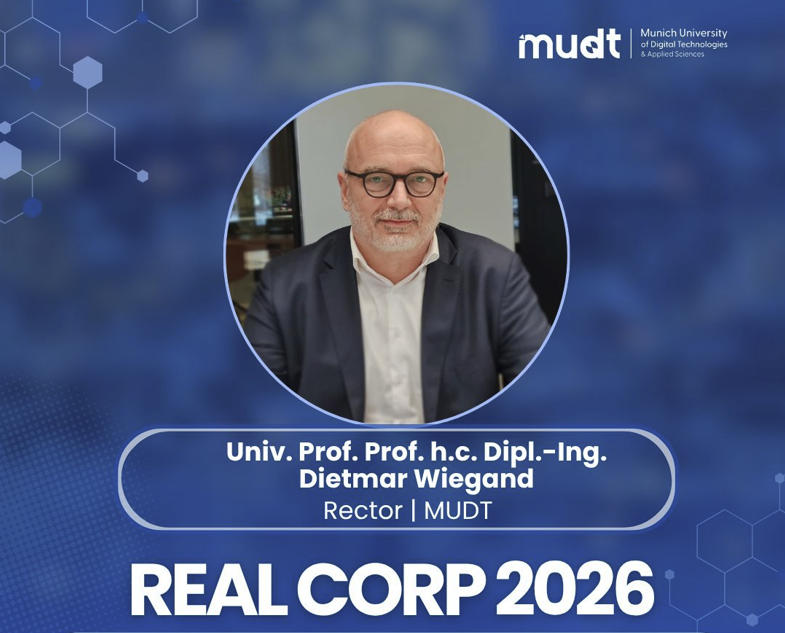
Input of Univ.Prof. Prof. h.c. Dietmar Wiegand, Rector at Munich University of Digital Technologies and Applied Sciences (MUDT), Professor for Real Estate Development and Project Management at Vienna University of Technology (TU Wien), Managing Director Institute of Property Research (IPRE)
Status: prefinal, the spoken word prevails.
Date 24.3.2026
Ladies and gentlemen,
Who had to learn the Pythagorean theorem in school?
Who can still remember what it says today?
a² + b² = c² It applies to all right-angled triangles and only to them. The area of the squares on the two sides adjacent to the right angle is equal to the area of the square on the hypotenuse, the longest side, opposite the right angle.
Who has ever needed the Pythagorean theorem in their professional or personal life? I haven’t, even though I studied architecture and became a professor of architecture. I need it now when one of my children has to take a math exam. Fortunately, two of my three school-age children attend alternative schools. They learn the material they need for the state-mandated exams on their own, in about a third of the time it would take them in regular schools. I still have one child in state school, and I had to teach him the Pythagorean theorem. But there is hope, a) because he has ChatGPT explain things to him after school and b) because he will soon be expelled from school; he is not well-behaved enough.
What can we learn from my children and Pythagoras for the future of education?
What questions must we ask ourselves when we talk about the future of education?
Lesson 1: Developments in AI are massively changing educational opportunities and research possibilities.
Each of us now has a fantastic teacher and a fantastic researcher in our pocket: a smartphone with an internet connection. However, we must learn how to use these new tools effectively. These new educational opportunities create unprecedented equality of opportunity in education. I’m not saying that all regional inequalities will be eliminated. We need a smartphone, the good fortune of owning one, and around one hundred euros a month for a few AI licenses, and we mustn’t live in one of the cities where mobile internet is currently blocked. And unfortunately, the number of these cities is increasing. Nevertheless, I maintain that AI creates unprecedented access to knowledge and education. AI has the potential to eliminate regional inequality to an unprecedented degree. But we must completely rethink education. My boys solve every math problem they’re given as homework in minutes using AI. We teachers therefore need to consider what skills they need and how we can teach them despite or with AI, because AI isn’t simply going to disappear from the world; it’s here to stay.
And in research? As a student, I had to painstakingly prove that my history and biology textbooks were wrong by visiting the university library. Today, it’s much easier. We can now research the current state of research on some topics in 10 minutes, something that would have taken us 3-4 months two years ago. However, I fear that teachers today will be just as unenthusiastic about a student questioning textbooks as they were back then.
Lesson 2: AI eliminates regional inequality and creates new regional inequality.
If we are interested in public education and eliminating regional inequality, many doors are open, more open than ever before! Many people carry a teacher and researcher in their pocket. But only a few countries can produce AI processors due to the necessary know-how and the need for rare earth elements (REE), which not every country has access to. Furthermore, the development of AI technology is reserved for companies that can pay salaries of €600,000 to €700,000 per year. AI data centers also require large amounts of energy, which is not readily available in every country in unlimited quantities and at affordable prices. AI therefore also creates new regional inequalities.
Lesson 3: There is still an enormous need for reform in education.
I certainly don’t have an overview of the global educational landscape, but in Germany, Austria, and many other European countries, the pre-university education sector has been in need of not just reform, but revolution for decades! Traditional lectures and the rote memorization of unnecessary knowledge must be replaced by competency-based learning. The shift from teaching to learning must be completed, and AI must be integrated appropriately, because it’s here to stay. And perhaps even more importantly: Obedience is still being cultivated; but to maintain economic competitiveness, we need disobedient people, people who question things, who think differently, who feel, who want justice. We need education for peaceful coexistence, not education for patriotism.
In light of AI, the OECD recommends that we send our children to art classes, let them learn a musical instrument, and give them opportunities to play sports. What distinguishes humans from machines is the capacity for innovation, not obedience. Emancipation is liberation from paternalism. We need people who can live and learn autonomously. Let’s at least let our children decide for themselves when and how quickly they want to learn mathematics, if we won’t let them decide whether we still need the ancient Pythagorean theorem. Let’s educate them to be responsible citizens, not dependent ones.
Lesson 4: Problem-solving skills are and remain of central importance.
Germany and Austria still enjoy a good international reputation and outstanding expertise in engineering. What do engineers do? They understand and solve complex problems. This problem-solving competence is of central importance for maintaining Europe’s competitiveness, for prosperity here, and also for the preservation of humanity. Consider, for example, the attempt to mitigate climate change and adapt to it, since we have not been able to eliminate it.
Lesson 5: Europe is developing into the school of the world and can also benefit economically from this.
If Europe succeeds in implementing the necessary reforms in the field of education, if Europe succeeds in consistently applying constructivist didactics, and if Europe continues to succeed in attracting international talent to study in Europe and to commit to the local economy long-term, for example through work contracts, then Europe can benefit from its excellent international reputation as a training center. Socially, because—as the rector of a young private university of applied sciences in Munich, I can attest to this—exciting young people from outside Europe will come here if we let them. Young people who can save the world; young people who are of interest to the European economy; young people who also think differently—and that is so important in the age of AI and in an age of increasing totalitarianism.
Thank you for your attention.
study AI in Germany – technology university Germany – engineering education future study engineering in Germany – study engineering in Munich – engineering university Munich